
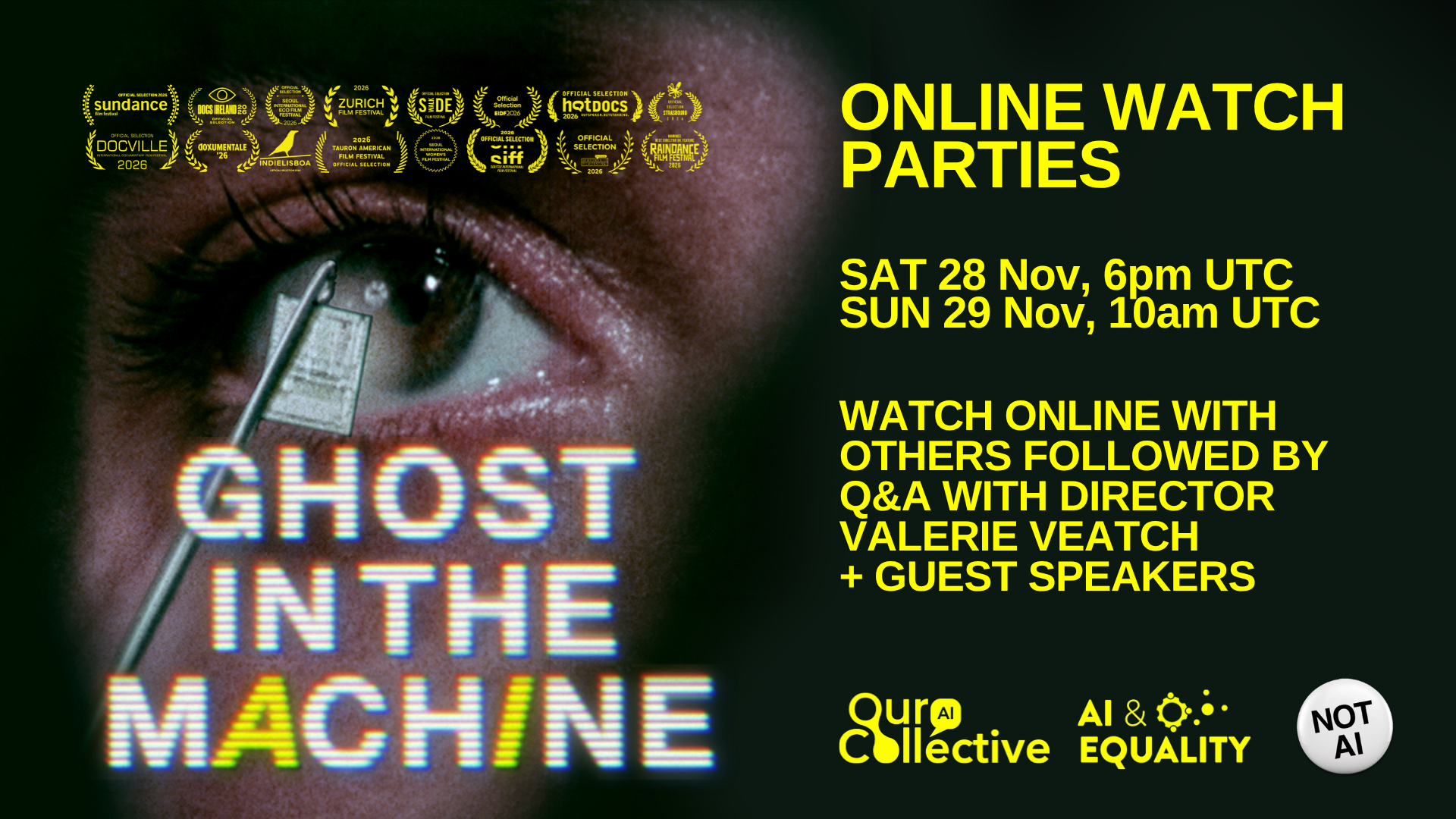
Steph Wright breaks down how an AI documentary is a really useful to support civic power through building critical AI literacy, and shares how to join an online community screening.
If you follow the debate around artificial intelligence, you’ve probably noticed something shifting. The environmental cost of AI is now mainstream knowledge. People know about the water consumption, the energy demand, the land grabs for data centres. Community resistance to these facilities is growing across the UK and beyond.
That’s a good start but it’s only part of the picture. And understanding the whole picture is key to countering the dominant narrative of AI inevitability. When the picture is so big, ways to help people connect the dots, a kind of accessible critical AI literacy, can be very useful.
1. Address what people may not yet know
Most people are now aware of AI’s material footprint. Far fewer are aware of what sits behind it.
The dominant narrative tells us AI is a neutral tool, a natural evolution of computing, an inevitable frontier. But the history of artificial intelligence, documented in university history and science studies departments, tells a different story.
Valerie Veatch’s 2026 documentary Ghost in the Machine draws on over 100 hours of interviews with more than 36 experts to lay out that documented history clearly and accessibly. It traces the intellectual foundations of AI back to early twentieth-century eugenics, showing how assumptions about what intelligence is, who can be measured, and what counts as progress carry forward patterns established in that era. It addresses the fact that the term AI itself was coined for funding purposes. It exposes the invisible labour that underpins AI systems, the underpaid workers in the Global South who label data, moderate content, and absorb the psychological toll that users never see. And it examines the worldview of the tech oligarchs funding these systems, shaped by troubling ideological commitments that range from techno-fascism to outright contempt for democratic accountability.
None of this is conspiracy. It’s research and reporting that is rarely translated for a general audience. The film does that translation. And in doing so, it helps to reframe how you understand the systems you interact with every day. If AI is constructed from particular values by particular people with particular intentions, then you can engage with it critically, question its premises, and imagine alternatives.
2. Treat knowledge as civic infrastructure
At Our AI Collective, we want to build civic power in AI. Power requires knowledge, not technical expertise, but historical and political literacy. Understanding why AI systems reproduce harm, not just that they do, is what transforms individual frustration into informed collective agency.
Ghost in the Machine is one of the most effective tools we’ve encountered for communicating that literacy. It prioritises accessibility over jargon and it leaves viewers with a sharpened awareness that AI is neither autonomous nor inevitable, and therefore open to scrutiny, contestation, and redesign.
3. Learn as a community (and join our watch party!)
That’s why we’re organising two online watch parties as we want to help get the film out to as many people as possible. We believe that watching and discussing together is how knowledge becomes shared understanding, and shared understanding is the foundation of civic power.
The environmental costs are increasingly known and this film will show you what else it costs, who it serves, and why.
The documentary team have been incredibly supportive of organisations holding in person and virtual screenings, so if you can’t join us, you will be able to find other dates, or even run your own!
Join us at these upcoming screenings from Our AI Collective and AI & Equality:
Session 1

Saturday 28 November 2026
18.00 UTC, 19.00 CET, 20.00 SAST, 21.00 EAT
Followed by live Q&A with director Valerie Veatch and guests Selam Abdella (Researcher, Global Center on AI Governance) and Prof Dagmar Monett (Professor of Computer Science, HWR Berlin)
Session 2

Sunday 29 November 2026
10.00 UTC, 15.30 IST, 19.00 JST, 21.00 AEDT
Followed by live Q&A with director Valerie Veatch and guests Nandini Chami (Deputy Director, IT for Change) and Akkanut Watanasombut (Head of ISSIE, Chulalongkorn University)