
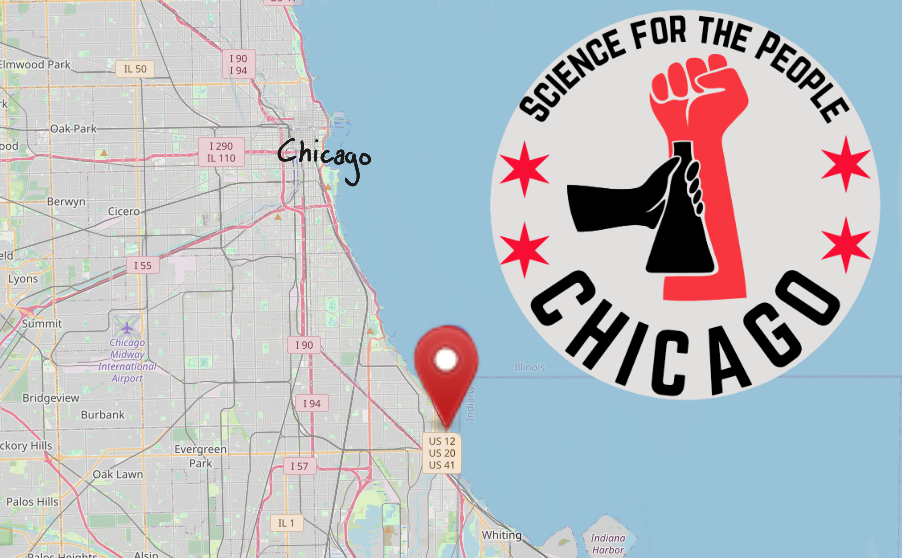
On the shore of Lake Michigan, in the south eastern part of Chicago, there was a steel mill for over 100 years. It was decommissioned in the 1990s, but now they are building something new on that land: a quantum computing facility called the Illinois Quantum and Microelectronics Park.
As we argue that AI is not inevitable, we must also recognize the problem of extractive technologies being pushed on people against their will goes far beyond AI. It is useful to pull back and look beyond the technical details of AI and see what we can learn.
In particular, as will be described in this interview, there are some key similarities between quantum and AI that make it useful to discuss. Quantum computing facilities have the same problems that lead people to resist data centers. The computing inside them is different, but the experience of living near them is essentially the same, meaning similar techniques are likely to work against both. Additionally, these are both unproven technologies that are being powered more by hype than their potential utility for the average person.
This interview is with Joshua Sodicoff, a doctoral candidate in Genetics at the University of Chicago and the co-Chair of the Chicago chapter of Science for the People. They have been involved in resistance to the Illinois Quantum and Microelectronics Park since February 2026.
What is the Illinois Quantum and Microelectronics Park?
The Illinois Quantum and Microelectronics Park (IQMP) is a 128-acre industrial campus meant to house massive quantum computers and associated fabrication facilities. It is located on the far southeast side of Chicago, on the former site of one of the largest steel mills in the region.
The steel mill has been decommissioned since the late 1990s but the land is particularly dirty from over a century of steel production. It is located in South Chicago, a dense, working-class neighborhood with a large African-American population and a rich heritage and history.
What is Science for the People? Who else is involved with this initiative?
Science for the People is a science activist organization with chapters across the US and beyond. Science activism is focused on the acknowledgement that all science is political. We reject the narrative that science is impartial and believe that the impacts of science are political, as well as the processes by which the science is done and disseminated. The work we do in Science for the People involves a) advocating for this perspective among scientific professionals and the public, and b) doing practical organizing work that builds off of these ideas.
I started this Chicago chapter in December of 2025 and we got involved with the campaign against IQMP in February of 2026. We were very interested in the rise in computing and the associated impacts of all that excess energy use. During this time, the number of people working on this has ranged between five to eight, in various capacities. We have all different types of backgrounds, from grad students like me to teachers to people who just care about the South Side. We’re not an exclusive group and you don’t have to prove that you can solve equations to be a science activist.
In terms of who else is involved: There is a whole constellation of organizations who are opposed to some version of the IQMP plan. One coalition of organizations is specifically seeking a Community Benefits Agreement (CBA) in order to get concessions related to environmental and economic impacts. We aren’t working with them because part of the issue is that quantum computing is essentially just a military technology and you can’t really oppose that with a CBA.
We initially were working very closely with Southside Together, which is a community organization that is very explicitly opposed to the project in its entirety. More recently we’ve been working with the organizations Concerned Neighbors of the Southeast Side, Black Alliance for Peace, Palestinian Youth Movement, and Code Pink as part of a network we just launched.
What is quantum computing and how does it relate to other extractive technologies like AI?
Fundamentally what’s different about a quantum computer from a classical computer – the type of computer we interact with regularly – is that instead of using a binary digital system of ‘bits’, quantum computers are able to take advantage of the properties of quantum mechanics to instead use ‘qubits’. While bits are either on or off, qubits represent a continuous value. Usually a quantum computer doesn’t exist on its own, but as part of a larger system of classical computers that control and measure and analyse.
The actual use of quantum computers is a whole different – and highly contentious – question. The claim is that quantum computers ‘do things faster’ because they run in parallel, but really they accelerate just a subset of algorithms that relate to quantum mechanics. The truth is that they are primarily used for experimentation and the only thing that they are useful for outside of theoretical application in cryptography is answering questions related to quantum mechanics that are difficult to simulate with classical computers. As such, projects like the IQMP rarely give a road map of when the applications will be viable.
Similarly to AI, quantum computing is being posed as new and innovative but it is unlikely to actually improve human life. However, I think a bigger parallel is the hype bubble. If anything it is more extreme for quantum computers because – to give AI a tiny bit of credit – AI does work for some things.
What actions has the initiative done?
As Science for the People, we are focused on both educating people about the material aspects of the project, and conducting our own research to develop a stronger and more direct case against it.
Initially we were focused just on education and dispelling misconceptions, and that is still a big thing that we do. We run teach-ins, both alone and with the other organizations that we collaborate with, as well as zines and other agitprop. We explain what quantum computing is and describe the environmental impact and how quantum computers are a military technology. We continue to act as a resource for other groups who are organizing against the quantum center because of how deep we are on the material aspects right now. For example, something we are looking into a lot more soon is formalizing like the case for why the commercial side of quantum computing is too insufficiently developed for it to make sense to fight for a CBA.
We also found ways many of us could use our scientific backgrounds to help with research. All of the information about the environmental testing and plans for remediation of the site were in an extremely dense five thousand page packet. We combed through the document and created a model for the long term outcomes of the site. Additionally, we started doing our own air quality measurements and soil testing of the site.
Another thing we’ve been doing is creating the most accurate analysis of the state of the project and of the infrastructure. We try to keep track of all of the documents and permits, as well as making connections with folks with either domain knowledge or more direct knowledge of the project to help us process what we are seeing. For example, some collaborators helped us track the progression of permitting for the cryogenic infrastructure, which is critical for this site and is going to be very important for continuing to organize around material development of the site.
How do you see your work in relation to the anti-data center movement?
At first, I didn’t really see what we were doing as part of the anti-data center movement but now I think it is very similar. Most of the differences come more from it being in the city than not being a traditional hyperscale data center. Optimistically, I think that our approach is doing something kind of different by attempting to get people with technical skills and research backgrounds to accelerate organizing.
Now I see us fairly closely tied and highly influenced by the anti-data center movement. It has been useful seeing the successes elsewhere, and learning what kinds of arguments are going to work, so we have a better sense of what arguments are similar enough to frame similarly. It is also just useful that now people have a profile of a data center in their heads, so we can use that. We have a zine about how they aren’t calling it a data center but it sure looks a lot like a data center.
What has the response been?
The response has been interesting and fairly diverse. We’ve gotten some very positive responses, because we spend a lot of time trying to get the word out and trying to make it easier for other people to organize on it. There are folks who are just not aligned with the way we’re organizing. This includes folks in the CBA coalition, where we’ve gotten mixed to negative responses.
We’ve got criticism for being scientists and not being neutral, for not being the right type of scientists, for being people from Hyde Park (editor’s note – this is the wealthy area of the South Side, where the University of Chicago is based) who don’t really know what’s going on here. These are all things that we think about very closely and try to account for. We collaborate a lot, and try to be very present in the area and work in coalition with groups that are embedded in the neighborhood.
The most encouraging response we’ve gotten is that the developers themselves are paying attention. The movement has managed to drag the argument a certain way, and changed what they talk about. So we do believe that something is happening. I think it is because they weren’t expecting an external group focused on calling them on their bullshit. I don’t think they were expecting to have to fight on the basis of the science and the commercial viability. We have their PR people sit silently on Zoom calls when we have public teach-ins and we welcome them.
What support are you looking for now and who could provide it?
I can answer this in two ways, thinking about “we” as in Science for the People, and “we” as in the movement to stop this facility.
I’ll start with the second. We’re looking for mass support in the community and across the city. We have to exercise every avenue possible in order to get this stopped. We need to increase public pressure, we need people to pressure their Alderpeople. We think there is an avenue for something relevant to go through city council, even if the mayor is not on board.
As Science for the People, we’re turning our sights towards lawfare, as well as attempting to build a stronger version of the technical and economic case. So what we really want is to inspire one lawyer with relevant background to want to represent us. It seems like we have a potential case, but there is a lot of complicated city politics around the IQMP and the universities and non-profits and that has made it hard to find someone to work with us. So we’re looking for legal representation, and we’re also looking for more experts, writers, and people who do comms. We’re really focused on installing as many delays in development as possible so that people have the time and space to organize properly.
What are your next steps?
Our next big step is trying to figure out how we can use the legal system as it is to delay or stop construction of this project. The remediation action plan has already been approved but we see an avenue to contest the reporting and planning and the assumed normal operations of the site. We are still getting the advice on how to proceed through this but we are going to focus both on the dust management at the site, which has been godawful. People who live next to construction are finding their windows caked in dust. We know that this dust is contaminated with heavy metals and scary VOCs so there’s a real impetus. Something has to be done because it will get people sick.
The other approach is that the remediation action plan is very lenient. They took the pathway for an industrial site that is going to stay as an industrial site, so instead of cleaning it up, they just had to argue that the pollution that is present is not mobile. They went through that, but it seems to be inaccurate. We’ve been doing our own soil measurements, and we have seen migration of heavy metals out of the site into the areas that normal people hang out.
We have also been thinking about how our efforts can have more diffuse benefits, specifically through the lens of education. We are going to be developing curriculums for adults and k-12, focused on how to organize against mega-developments, as well as how can individual people contest environmental reporting that is being used to whitewash these things. We hope to create a module that uses the original data from this project soon.
Is there any advice you want to give others?
This is advice to someone who has identified either a data center being built or a plan for a data center that they do not like. You should read and listen and talk to people before physically doing that much. It’s kinda like the saying “measure twice, cut once”. When you see these projects, acting strategically and going in with all of the context on the specific case really does help. I say this because I don’t think we did this as effectively as we could have.
The other aspect is that there’s a crazy amount of energy behind the anti-data center movement, but it’s not unified in other ways. Maybe you stop the data center, but people might still think and feel exactly the same way and might still love AI. People who don’t like data centers but love AI are very present in the movement. So think about how you can get them to go deeper than just the data center.
Please note that answers have been paraphrased and edited for length and clarity. An audio recording was used for reference while writing.