
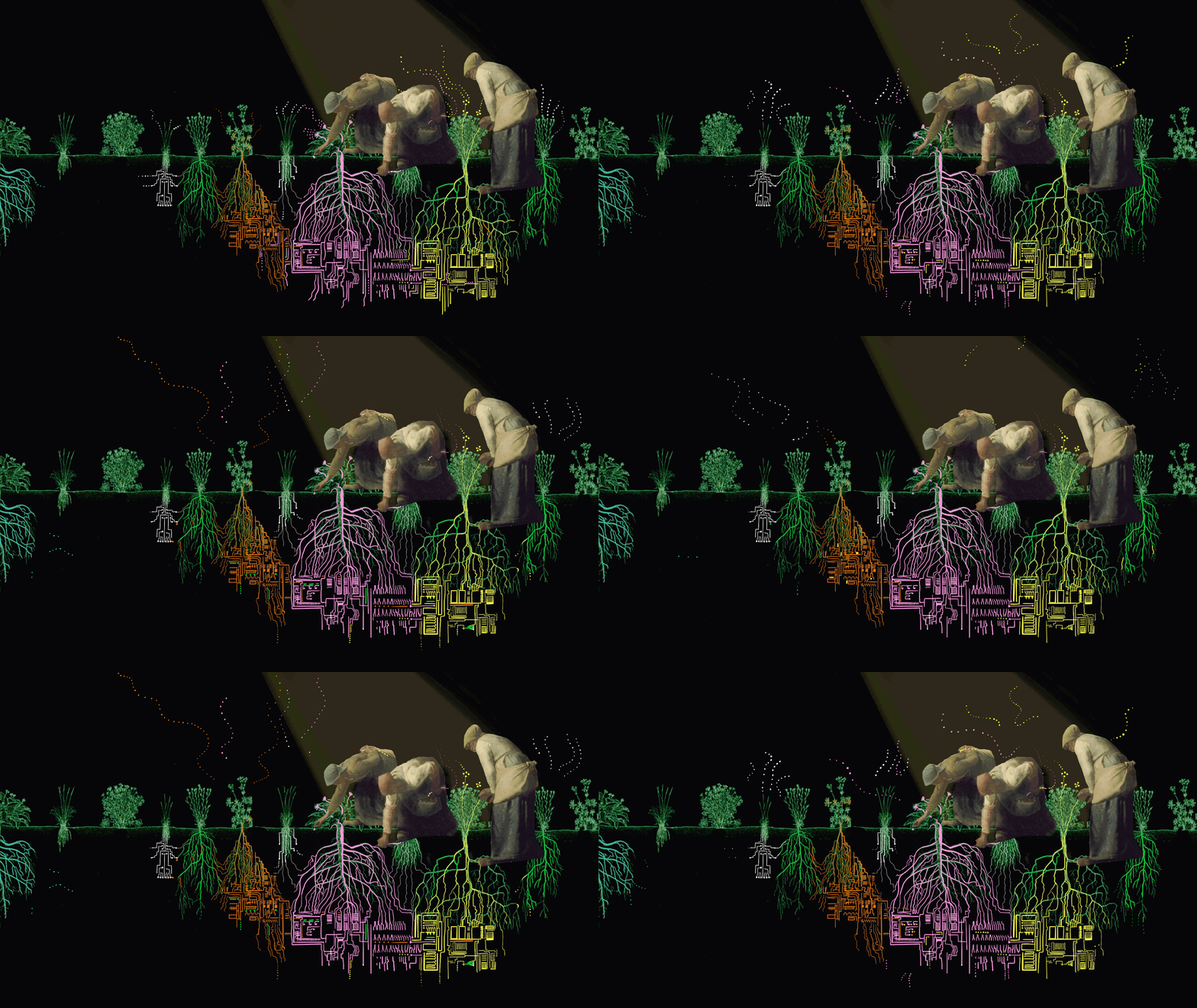
The development and deployment of large-scale generative AI has been a massively undemocratic enterprise. But there are many resisting the pull, and in May 2026 we started the AI Resist List to document them. A journalistic endeavor led by Karen Hao and AI researchers, journalists, and critical scholars, we came together through a shared desire to tell the underreported stories of how people are refusing to accept that better futures are not possible. We called it a “Resist List” because we believe that resistance is inherently generative. Resistance paves the way for new ideas, thoughts, and projects. Resistance is at the core of democracy. Faced with injustice, we organize campaigns, petition, and protest.
We saw that there are increasing protests against hyperscale data centers. Not just because of their environmental impact, but as a way of challenging the physical infrastructure which is replacing humans and destroying some of the institutions that are at the core of our democratic process such as journalism, education and human connection. Datacenters are being built via backdoor agreements, enabled by large-scale data theft, and are the engines of widening power asymmetries and increasing inequality – all counter to democratic values.
The AI Resist List featured many other types of challenge to antidemocratic AI, or used democratic processes to challenge harmful use. For example, the group Tech Justice Law, a litigation and advocacy organization, filed lawsuits against Character.AI, Open AI and Google. These sparked a global public conversation and significant policy momentum over how to prevent such psychological harms. Friends of the Congo resist exploitative resource extraction, while others organise worker-led campaigns against the deployment of AI at work such as Tech Workers Coalition, or fight for the rights of data workers such as the Data Labelers Association.
Since then, we have seen that others seeking to support democracy are focusing on exploring ways in which, if built differently, AI might strengthen democracy rather than erode it. This was the challenge set by Mozilla Foundation’s Democracy x AI Incubator cohort. Over a year, ten project teams from around the world are being offered coaching, advice and peer mentorship as they build and test new ways to support democratic processes with AI.
We were interested to consider what we can learn from researching the AI Resist List to offer as inspiration or guidance to the Democracy x AI cohort. Having documented how initiatives around the world are pushing back against pillars that uphold this extractive empire in many different ways, what did we see about how they upheld foundational values? How do the shared hopes between collaborators collectively imagining better tech futures stay rooted in justice and regeneration for people and the planet, rather than following existing models of technology?
These are three key tips we can share.
1. Complicate the term AI
The term “AI” has no single definition.
While data centers in Quilicuira, Chile are draining water from areas already experiencing severe drought in the name of developing indeterminate AI technology, Dr. Keolu Fox and his team are designing “data terrariums”. These are renewable-powered microdatacenters working with discarded GPUs focusing on small machine learning models for genomics research, trained on community-curated datasets.
While OpenAI stole vast amounts of data from authors around the world to train their language models, the broadcasting and tech hub Te Hiku Media is using a model locally trained on data collected within the community to revitalise the Maori language, te reo.
At the same time as AI models are creating ‘bot farms’ to sway political opinions on social media, the NGO Correktiv built a censorship-tracker for Turkish media, automatically detecting where authorities are intervening in reporting.
It’s clear that what people refer to as “AI” ranges from environmentally-destructive large-scale generative AI models dominating today’s market to locally-hosted small machine learning models trained to do a very particular task. When we refuse to use “AI” as a blanket term, and instead name specific technologies and their origins and purposes, we can separate the massively destructive technologies from those with real benefit.
2. Consider who needs to be involved from the start – and how
The development of AI technologies should follow principles and methods of codesign and participatory governance, centering the needs and priorities of those most marginalized and most likely to be impacted. They should be equal partners. External researchers need to have, lived experience literacy – requiring a paradigm shift in the value afforded to expertise gained through first-hand experience. This mitigates the risks of ‘participation-washing’, and lays the groundwork for more meaningfully participatory forms of AI development.
The true stakeholders in AI development are not only the shareholders of tech companies – they also include the people mining the metals to build computers; the people whose data is used to train models; the planet on which all of this is happening. Rather than being built by a small few to maximize profit at the expense of many, the development of AI technologies should be a negotiation between its stakeholders at every level.
We can use the principles of co-design, participatory governance, and lived experience literacy to make sure that those most marginalized in our current system can lead the way towards technology that truly benefits humanity.
3. Engage critically with the ways AI solutions can strengthen democracy
Finding technologies which could be at the service of democracy requires very careful and critical analysis. Indeed, framing AI as a solution to social issues has been at the core of the discourses pushed by big tech corporations for decades and has long served as an excuse for the large-scale environmental and social costs of the technology. It is therefore central to any discussion on AI and democracy to really ask ourselves:
- How did power shift when this technology was created? How is power shifted when it’s used? This is not a simple answer, as something on the surface that may seem “pro-democracy” (e.g. a chatbot that tells you about your voting rights) may be part of a much larger project undermining democracy (e.g. mass data theft and surveillance done by OpenAI to build said chatbot). Any technology has to be considered holistically. Even something that may seem harmless on the surface may be connected to something much larger.
- What social problems is this AI system promising to solve? What other solutions exist and is technology really the right answer?
We need to beware of technosolutionism – the idea that technology can fix complex social problems. Indeed, technological solutions often end up simplifying a complex issue into a quantifiable problem, thereby leaving out important context and lacking an understanding of underlying mechanisms and systems. It is therefore important to always be clear on what the problem is that one wants to tackle, and to critically examine whether technology is the right answer for it.
- What human connections do you take away when introducing this technology?
Democracy is inherently human. If AI systems are implemented to simplify discussions, help form opinions or write text for you, they might make human processes more efficient, but they also reduce human connection and necessary friction. Ask yourself, in prioritizing efficiency in a democratic process, are you de-prioritizing something more important? Always examine what human connections are replaced or diminished by the introduction of an AI system.
Democracy has many forms, from representative democracy to participatory and deliberative, but central to all of these forms is the ability for people to express their opinions and to have the power to influence governance.

The idea of AI came from the intention to mimic, automate or replace human capabilities, such as language-related tasks as we see with the rise of generative AI. We therefore need to acknowledge that there might be an unresolvable, inherent tension between AI and democracy, but also that AI reaches to the very core of what democratic processes are all about. Having an open mind and constantly evaluating and considering the wider implications of technological solutions can help to navigate these tensions.
We must also be thoughtful and honest in assessing how AI companies are achieving their aims and playing a part in a more regenerative movement for people and planet. Resisting, refusing, reclaiming and reimagining at the intersections of AI and democracy can create the conditions for challenges against many other pillars of AI Empires.
We must explore critical, collaborative, and hopeful approaches, which refute the idea that ‘AI’ as it is is inevitable. We’re fascinated to see what comes out of this cohort as they navigate these tensions and foster a better future of technology and democracy.
To find out more about the varied projects in the Mozilla Foundation’s AI x Democracy Cohort, which includes projects from Japan, The Phillipines, Chile, US, Spain, Germany, Czech Republic and Uganda, visit the project page here.
Thanks to Mozilla Foundation’s editorial site Nothing Personal for commissioning our musings on what to consider when exploring AI to support democracy, and also the stunning accompanying artwork from the incredible artist Hanna Barakat.
Versions of Hanna’s images will soon be available for free download with attribution in the Better Images of AI image library.